By Geoff Kreegher (Hamilton Ratepayer)
[Geoff Kreegher’s feedback to IAWAI Water Services Strategy 2026 – 2036 on 31 March 2026]
IAWAI’s Proposed Growth Charges Spark Concerns over Fairness, Transparency, and Evidence
As IAWAI prepares to take control of water services across Hamilton and the Waikato district from 1 July 2026, its draft Water Services Strategy has triggered strong criticism that the organisation’s plan to introduce new “growth charges” is premature, poorly justified, and risks embedding inequities into the funding of water infrastructure for decades.
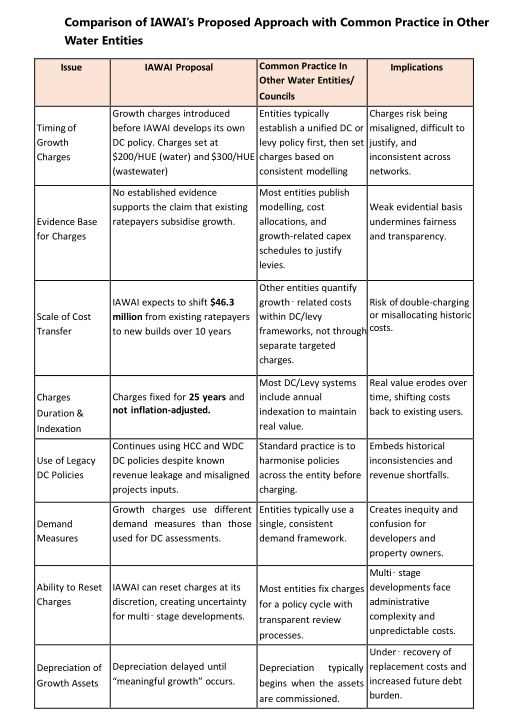
IAWAI’s proposal would see new builds pay additional fixed charges—$200 per household unit equivalent (HUE) for water and $300 per HUE for wastewater—for 25 years. These charges would sit on top of existing development contributions (DCs) and capital payments already required at subdivision or building consent stage. The organisation says the charges are needed because “existing ratepayers have effectively subsidised growth for many years,” though the draft strategy provides no evidence to support that claim.
With no evidence, the proposal risks being perceived as “plucked out of the air” designed to shift costs from existing to future users rather than a principled funding mechanism.
A Call for Evidence Before New Charges Are Imposed
A central issue: IAWAI has not demonstrated that past growth has failed to pay its way. The organisation should first quantify:
- how much historical growth has contributed to depreciation and financing of existing assets, and
- the extent to which unrealistic growth projections—particularly those underpinning Housing Infrastructure Fund (HIF) loans—have inflated costs for ratepayers.
Both Hamilton City Council (HCC) and Waikato District Council (WDC) have experienced mismatches between projected and actual growth, leading to early borrowing and under‑recovery of DC revenue.
Without this analysis, IAWAI cannot credibly claim that new builds should shoulder an additional $46.3 million in costs over the next decade.
Misaligned Development Contribution Policies Add Complexity
A second major concern is the inconsistency between the DC policies currently used by HCC and WDC. IAWAI plans to adopt these policies unchanged for 2026/27 before developing its own DC framework the following year.
But the two councils’ policies differ significantly in:
- demand modelling
- interest rate assumptions
- treatment of HIF‑funded projects
- demand conversion factors
- inflation adjustments
- incentives for preferred development areas
- timing of DC assessments⁴
These inconsistencies make it impossible to ensure that the proposed growth charges are fair or accurately reflect the true cost of growth across the various closed-access networks IAWAI will inherit.
It is recommended that growth charges be delayed until IAWAI has created a unified, transparent DC policy of its own.
Multi‑Stage Developments Face Administrative Confusion
The draft strategy allows IAWAI to reset growth charge rates at its discretion in future years. While this flexibility may help the organisation respond to changing costs, it creates significant uncertainty for multi‑stage developments such as retirement villages or large commercial complexes.
Different stages could attract different growth charge rates, each expiring at different times; this will create “additional administrative complexity and ongoing charge transparency issues” for property owners.
There is no simple solution that would guarantee fairness for all parties.
Delaying Depreciation Risks Underfunding Future Asset Renewal
Perhaps the most consequential concern relates to IAWAI’s proposal to delay depreciation on assets built with growth capacity until “material growth” occurs.
This undermines long‑term financial sustainability. Most water and wastewater assets serve both existing and future users from day one, delaying depreciation means the organisation will under‑recover replacement costs.
This would force future generations to take on more debt—an issue already affecting IAWAI as it inherits significant liabilities from predecessor councils.
It is recommended that depreciation begin in the financial year immediately following asset completion, consistent with standard infrastructure funding practice.
A comparison of IAWAI’s Proposed Approach with Common Practice in Other Water Entities is below.
https://acrobat.adobe.com/id/urn:aaid:sc:AP:652d07b9-a654-4001-a187-69437ad7b798
Also on the last page.
Peter Winder’s admission: the programme was “substantially a continuation of what has been done before because we did not have time or resources to start from square one with a blank sheet of paper and think about life.” There was a lot of work to be done by next year on the next water services strategy, he said, and maximising existing infrastructure would be critical for being cost effective…”
There must be no IAWAI-related project contracts signed, including the Ruakiwi/lake reservoir build, until options are reviewed relevant to today’s circumstances (growth projections, economic & geo-political climate). E.g. HCC’s huge take-up of treated water (drinking water) to keep sports grounds & parks green rather than installing rainwater storage and obviate the need for Ruakiwi – together with growth projection reviews!
Papakainga Waivers Under Scrutiny: Who Really Pays for Growth?
A quiet clause buried within IAWAI’s strategy is raising uncomfortable questions about transparency, fairness, and the shifting burden of urban development costs. At issue: a proposed policy mechanism that would allow development contributions for papakainga housing to be discounted—or waived altogether—through negotiation rather than through a clearly defined, publicly consulted framework.
While the intent of supporting papakainga development aligns with longstanding efforts to improve Maori housing outcomes, critics argue that the way this policy is being introduced risks undermining core principles of local government accountability.
The draft strategy makes no explicit reference in the consulted Waiver Policy, nor does it outline a transparent decision-making framework for how such waivers would be assessed or granted. Instead, it appears to allow for case-by-case negotiation behind closed doors—a move described as “autocratic” and lacking procedural integrity.
This omission is significant. Under the Local Government Act 2002, councils are required to consult the public on policies that materially affect rates, development contributions, and the distribution of costs across the community Bypassing or sidestepping this process raises the spectre of decisions being made without adequate public scrutiny.
The Auditor-General has previously warned against exactly this type of drift, noting that “clear, consistently applied policies are essential to maintaining public confidence in local government decision-making.”
The papakainga housing waiver proposal should be revised and done in a way that is transparent, equitable, and democratically accountable, i.e. consulted on.
Summary
A Strategy under Pressure
IAWAI’s Water Services Strategy is one of the first major policy documents produced under New Zealand’s new water services framework. It arrives at a time when water infrastructure costs are rising sharply nationwide, and councils are under pressure to demonstrate that “growth pays for growth.”
Without clear evidence, consistent modelling, and transparent processes, IAWAI risks embedding inequities into its funding system before it has even begun operating.
The organisation is expected to review public submissions before finalising the strategy later this year.
Recommendations:
It is recommended that:
- Growth charges are delayed until IAWAI has created a unified, transparent DC policy of its own.
- Depreciation begins in the financial year immediately following asset completion, consistent with standard infrastructure funding practice.
- No IAWAI-related project contracts are signed, including the Ruakiwi/lake reservoir build, until options are reviewed
- The papakainga housing waiver proposal be revised and done in a way that is transparent, equitable, and democratically accountable.
[The content of any Opinion pieces represents the views of the author and the accuracy of any content in a post labelled Opinion is the responsibility of the author. Posting of this Opinion content on the CityWatch NZ website does not necessarily constitute endorsement of those views by CityWatch NZ or its editors. CityWatch NZ functions to provide information and a range of different perspectives on New Zealand’s cities and local councils. If you disagree with or dispute the content, CityWatch NZ can pass that feedback on to the author. Send an email to feedback@citywatchnz.org and clearly identify the content and the issue.]
Further reading on this issue
Household Water Costs in Hamilton City Projected to Triple within 9-years under New Water Company


