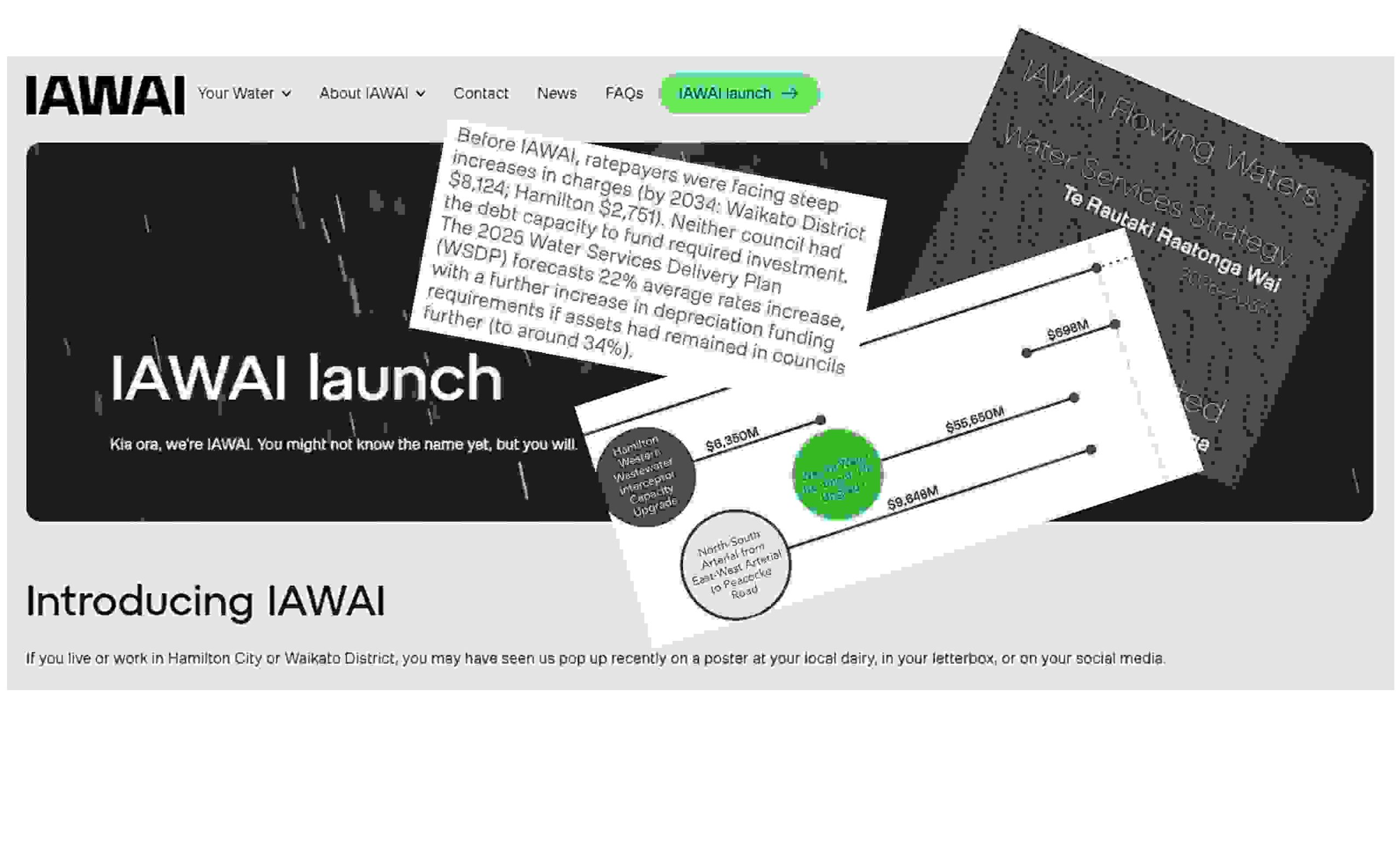
John McDonald (CityWatch NZ editor) supplies a copy of his open letter to the Minister of Local Government sent on 26 June 2026.
26 June 2026 Open Letter to Ministers
The letter raises many concerns about the lack of transparency and that water bills in Hamilton City are projected to increase greatly over the next decade under IAWAI.
The central part of the letter asks for ministerial intervention and for central government officials to confirm Where the following points are accurate or inaccurate. John McDonald thinks that most of these points are false and this undermines the case for forming the joint CCO.
- That central government would not approve an in-house option for Hamilton water services.
- That Hamilton City would definitely breach its debt limit if it did not form a CCO.
- That forming a CCO was needed to access the higher (500% of revenue) borrowing limit from LGFA (implying that a ring-fenced in-house division was unable to borrow to 500%).
- That supplying water services across council boundaries is only possible by forming a joint-CCO with neighbouring councils.
- That “price harmonisation” is mainly about the change from charging based on capital valuation to volumetric charging (instead of it being mainly about water charges in Hamilton City needing to rise greatly to achieve equity with the approximately threefold higher charges
typically experienced by households in Waikato District). - That the projection of a $4347 annual water bill 3 for a median household in 2034, is effectively for older in-house options and therefore not relevant to the joint delivery model (which would be named IAWAI).
- That forming the joint-CCO will deliver affordability benefits to Hamilton households in terms of lower than expected water charges over a 10 year timeframe when compared to the in-house option.
- That a +22% increase in population over the next 10 years for Waikato District and Hamilton City is still a robust estimate.
John McDonald alleges that council staff and/or consultants mislead Councillors and the general public about some of the above points, to favour the joint-CCO option over the in-house option which had better affordability for households in Hamilton City.
Links to John Mcdonald’s supporting documents can be found below:
- Council-Open-Agenda-25-June-2026.pdf, see pages 15-22 for my presentation to a previous council meeting and pages 36-41 for the “IAWAI Readiness for Go-Live on 1 July 2026” letter from Chief Executive Peter Winder.
- 24 June 2026 Open Letter to HCC.pdf for my response to the claims made in the “IAWAI Readiness for Go-Live on 1 July 2026” letter from Chief Executive Peter Winder.
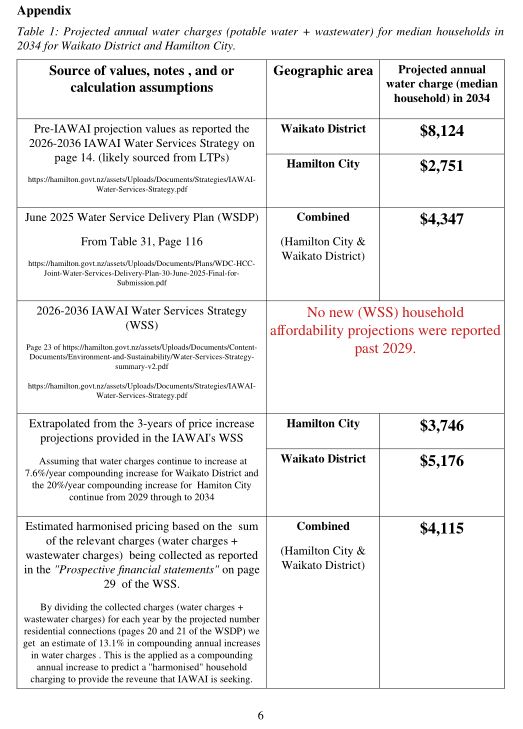
John presents this table for projected media household water bills in 2034 (both numbers officially released to the public and numbers he has had to estimate based on limited data supplied by IAWAI and Hamilton City Council)
John McDonald has also been helping with the STOP IAWAI campaign launched in mid June 2026
STOP IAWAI can be found on on Facebook here where campaign updates will be posted:
https://www.facebook.com/people/STOP-IAWAI/61590619261373/
Quotes
“To the Minister of Local Government and the Deputy Minister of Local Government,
(as copied to the Mayor of Hamilton City as well as Hamilton City’s Councillors and Members of Parliament)As I am sure your are aware, Wellington’s new Tiaki Wai water CCO released its 2026-2036 Water Service Strategy which projected that annual water bills for median residential connections would increase to over $6800 by 2036.
In some ways, the situation is worse in Hamilton City with our new CCO named IAWAI.
My projections indicate that annual water bills for median households will increase to somewhere between $5000 and $6000 in the year 2036 under IAWAI.
This amount might not be quite as high as projections for households down in Wellington.
However, the median household in Hamilton City is reported by IAWAI to be currently paying $940 per year in rates for potable water supply and wastewater services.If the water bills for a median household in Hamilton City increase sixfold to $5640 per year, then that would place them within my range of projections for 2036. This magnitude of price increase represents a major burden on residents within Hamilton City, especially in circumstances of a well-known cost-of-living crisis.
Unlike Wellington’s current situation, in Hamilton City we need to do our own projections about our new CCO because IAWAI has only released cost-per-median-household projections for its Water Service Strategy (WSS) until 2029.”
Dr John McDonald-Wharry, Open letter to the Minister of Local Government, 26 June 2026.
“Had Hamilton City not joined IAWAI, the median household in Hamilton City was projected to have an annual water charge bill of $2,751 in 2034. The 2025 WSDP combined Hamilton City and Waikato District together and arrived at an annual water charge bill of $4,347 in 2034. Based on the those values, IAWAI (or more specifically “price harmonisation”) is expected to cause households in Hamilton City to be paying $1596 more (+58%) in projected water bills by 2034.
These are significantly higher projected water bills when compared to the in-house option.”
Dr John McDonald-Wharry, Open letter to the Minister of Local Government, 26 June 2026.
“Where Tiaki Wai released its household water charge projections out to 2036, IAWAI is not releasing their new projections past 2029 (claiming not to have even modelled such “price harmonisation” scenarios).
Extrapolating out the compounding increases, which can be calculated from data available in the WSS, we can estimate annual water bills for the median Hamilton City household at either $3,746 (incomplete “price harmonisation”) or $4,115 (complete “price harmonisation”). This is still represents an annual water bill between $995 and $1,365 higher (+36-50%) than what was expected pre-IAWAI.
Dr John McDonald-Wharry, Open letter to the Minister of Local Government, 26 June 2026.
[The content of any Opinion Pieces or Open Letters represents the views of the author and the accuracy of any content in a post labelled Opinion or Open Letter is the responsibility of the author. Posting of this content on the CityWatch NZ website does not necessarily constitute endorsement of those views by CityWatch NZ or its editors. CityWatch NZ functions to provide information and a range of different perspectives on New Zealand’s cities and local councils. If you disagree with or dispute the content, CityWatch NZ can pass that feedback on to the author. Send an email to feedback@citywatchnz.org and clearly identify the content and the issue.]
[Graphics were constructed from the IAWAI website https://iawai.co.nz/do-it-online and the 2026-2036 IAWAI Water Service Strategy. Any copyrighted material is being used under fair dealing for the purposes of criticism, review, and news reporting]
Further reading on this issue
OPINION: Have IAWAI and NZ Water CCOs Been Given a Back Door Around Rates Caps?
OPINION: Bad Faith, a Missing Graph, and the Creation of the IAWAI Water Company
Household Water Costs in Hamilton City Projected to Triple within 9-years under New Water Company
Backlash Grows Towards Wellington’s New “Tiaki Wai” Water Company: May 2026 Media Coverage