By John McDonald (CityWatch NZ Editor)
Summary
This opinion piece covers the formation of the new IAWAI water company which is set to take over the water infrastructure and water services from Hamilton City Council and Waikato District Council in early July 2026. This article covers three different official documents released to the public between December 2024 and April 2026, and highlights missing information and how the public is being mislead about how much the new water company will increase costs for the households in Hamilton City.
This article focuses on three public documents involved in creating the new IAWAI joint water company:
- The 2024 Business Case (which was missing the graph which indicated that keeping water services within Hamilton City Council would result in lower annual water charges for Hamilton households than forming a new joint water company).
- The 2025 IAWAI Water Service Delivery Plan (which showed a plan to increase average household water costs by at-least threefold before 2033… this projection was released after the council’s vote to establish this new water company).
- The 2026 IAWAI Water Services Strategy (which did not publicly release any projections for household water costs past 2029… Wellington’s strategy publicly released projections out to 2036 where they were $6831 per average household per year).
“Three Waters“ and “Local Water Done Well“
Efforts have been made for many years to get councils in New Zealand to hand control of their water infrastructure and services over to larger corporate entities.
Under the last Labour government this process was called “Three Waters“ and was going to forcibly transfer water infrastructure from councils to new regional water entities with corporate structures and iwi co-governance.
Before the “Three Waters“ proposals, the wider Auckland region had their municipal water services managed by the corporate entity called Watercare. Likewise, councils in the wider Wellington region had placed their water infrastructure management into the hands of an entity called Wellington Water. Both corporate entities are owned by their councils and are called council-controlled organisations. Wellington Water has awarded long-term contracts to the multinational corporation Veolia to run treatment plants which have then had catastrophic failures or persistent faults. Both Watercare and Wellington Water have a history of high costs, failing infrastructure, and effectively act as a barrier to democratic accountability. Watercare and Wellington Water do not serve as good examples for the benefits of council-controlled organisation (CCO) model for managing water services.
After the Labour Party lost the 2023 election and after the “Stop Three Waters“ campaign, the coalition government reversed the “Three Waters“ reforms and replaced them with the “Local Water Done Well” reforms. The “Local Water Done Well“ still encourages councils to form joint water companies, though this was meant to be more voluntary with less co-governance imposed from central government when compared to Labour’s reforms.
The December 2024 Business Case
The public face of Hamilton City Council’s proposal to form a joint water company with Waikato District Council was represented in a Business Case finalised in December 2024. This business case compared the different options: keeping water services in-house (the status quo), Hamilton City Council forming a water company alone, or Hamilton City Council forming a joint water company with Waikato District Council. The new water company would be a council controlled organisation (CCO).
This Business Case report was very supportive of forming the joint water company, concluding that forming the joint water company was the best option. A weighted set of criteria was used to assess four options, with “improves affordability for the ratepayers” benefit contained in a small section which was only weighted at 12.5% of total assessment. The rest of the criteria sections were fuzzy, subjective, and non-quantitative.
In my opinion, most of the purported benefits of the joint water company could be achieved while keeping Hamilton’s water services as a council department and forming agreements with other councils (such strategic workforce development and skill sharing collaborations and bulk purchasing arrangements).
In the 2024 Business Case, the financial impact on consumers was represented by “annual change in average rates per connection” graphs with Compound Annual Growth Rate (CAGR) values.
These graphs and the CAGR values were displayed for all options, except Option A2 “HCC Status Quo”. The projected increase for households in Hamilton, if the City kept direct control of its water infrastructure was left out of the report. The differences between the CAGR values for the different options are small, only 0.2%. However, the joint CCO was promoted as the option which “improves affordability for ratepayers”. The CAGR values for “average rates per connection” did not support that conclusion, and the graph which would indicate if Hamilton City households would pay more each year under the CCO option was left out of the Business Case released to the public.
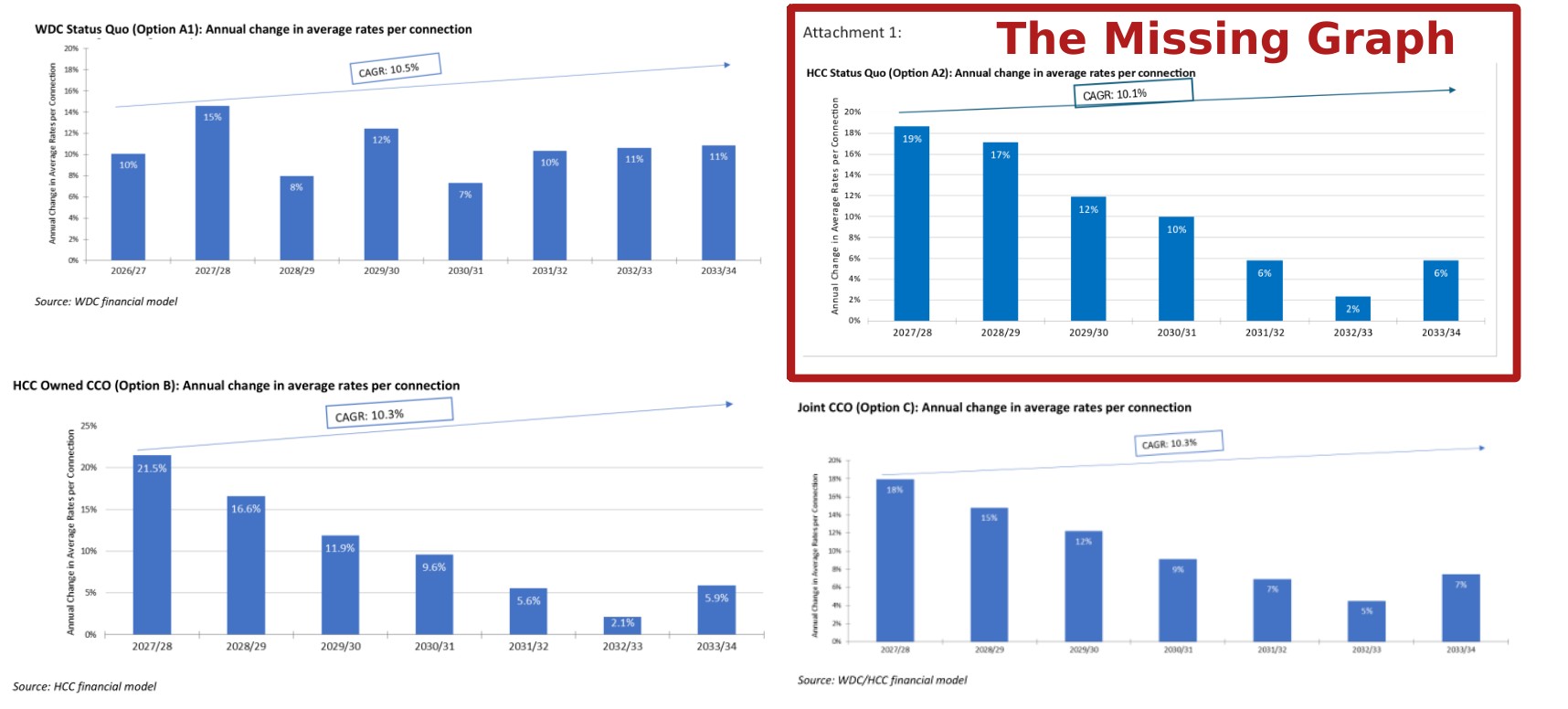
Graphs from pages 41, 45, and 51 from the Local Water Done Well Business Case FINAL December 2024, except the Missing Graph which was released to John McDonald on 4 September 2025.
The IAWAI joint water company is born and the 2025 plan (WSDP) is released
Based on this Business Case, there was a public consultation and Hamilton City Council voted to transfer water infrastructure and services to a new corporate entity. With a plan to also incorporate the water infrastructure from the neighboring Waikato District Council, the new corporate entity was branded IAWAI. The complete merger into the new water company is scheduled for 01 July 2026.
After challenging the new IAWAI establishment board in late 2025, they released the missing graph which showed that Option A2 (Keeping Hamilton’s water services in-house) had the lowest CAGR of 10.1% (compared to 10.3% for creating the joint water company). This graph, missing from the 2024 Business Case, undermined the already weak case that the joint water company was in best interest of households in Hamilton City. Households in Waikato District would get lower annual water costs under the joint water company if the Business Case’s projections were accurate. Households in Hamilton City were getting a worst deal under the joint water company compared to those in Waikato District, especially in terms of annual household costs after 2032.
Following the councillors voting to form the new water company, the Water Service Delivery Plan (WSDP) was released to the public in June 2025. The CAGR for the increasing average household costs was now 12.7%, corresponding to the average household water bill tripling by 2033-2034.
The 2026 IAWAI Water Services Strategy (WSS)
In early March 2026, the Water Services Strategy (WSS) was released for public consultation. The projections changed considerably in both the WSDP and WSS, with little consistency in terms of how household costs and affordability was calculated and presented. In the newest projections, increases for households past 2029 were noticeably missing. This can be seen with the post-2029 WSS data missing in the following two graphs.
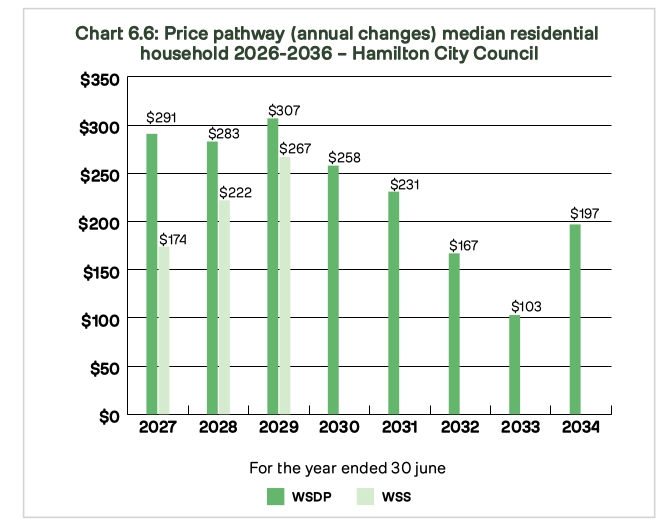
Page 25 of the IAWAI Flowing Waters Water Services Strategy (Te Rautaki Raatonga Wai) 2026–2036
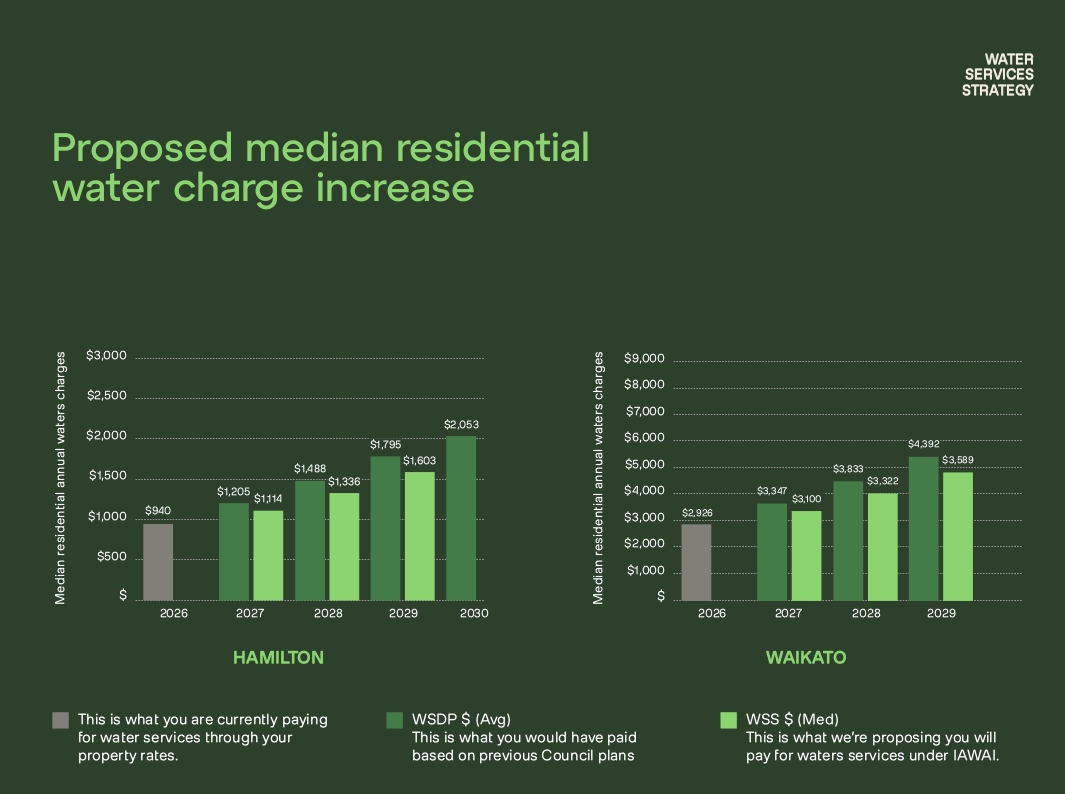
Page 23 of the IAWAI’s “summary of our Water Services Strategy 2026–2036″ document.
Key points based on IAWAI Water Services Strategy (WSS), include:
- The average Waikato District Council household is currently paying $2926 per year for water services.
- The average Hamilton City Council household is currently paying $940 per year for water services.
- Waikato District Council has been paying Auckland’s Watercare CCO for water services. Is the CCO model itself a major cause of the higher household water costs? (small towns might face higher cost and lower efficiencies compared to city-scale treatment plants).
- IAWAI only put three years’ worth of projected costs-per-average-household (out to 2029) in its WSS reports.
- Based on these limited projections in the WSS, Waikato District Council households are facing much lower increases than households that have been paying rates to Hamilton City Council.
- Wellington City was given projections out to 2036 from their new water company (Tiaki Wai) with the average household charges projected to increase from $2100 a year to $6831 over 10 years.
- The concept of “price harmonisation“ between HCC households and WDC households was part of the Business Case in 2024 and this was repeated in the 2026 IAWAI Flowing Waters Water Services Strategy
“Develop a staged approach to price harmonisation between Hamilton City and Waikato District for the services requirements. Over time, this will mean consistent prices, irrespective of where people live.”
IAWAI Flowing Waters Water Services Strategy Summary, page 16
-
IAWAI Flowing Waters Water Services Strategy 2026 is projecting only 3 years ahead, with average households facing 20% per year compounding increases in water costs for Hamilton City residents and only 7.6% per year compounding increases in water costs for Waikato District residents.
-
If those different rates continue for the next 10 years, the average households in Hamilton City and Waikato District will have similar annual water charges, these are estimated to be $6449 (WDC) and $6893(HCC) per year in 2037. Around 2036, WDC and HCC median household bills are projected to be equal at approximately $6000 per household per year. Note that this is not contained in the Waters Water Services Strategy, because they did not publish the new projections past 2029. It is speculation that average household charge will be over $6000 per year. However, it is educated speculation based on the published trends and what is left out of the public-facing strategy document.
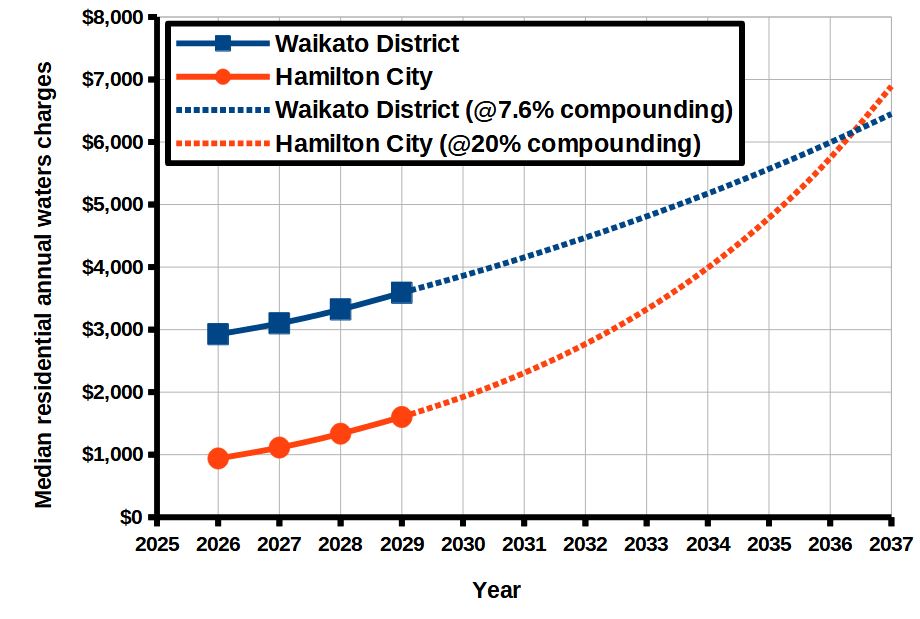 Projections and extrapolations: Is this the expected impact of ” smoothing price increases” and “price harmonisation” past 2029?
 -
It is interesting that these extrapolations achieve price harmonisation at around 10 years time, and the 2036 household average prices are very similar to what Wellington’s Tiaki Wai has projection for their average household cost in 2036.
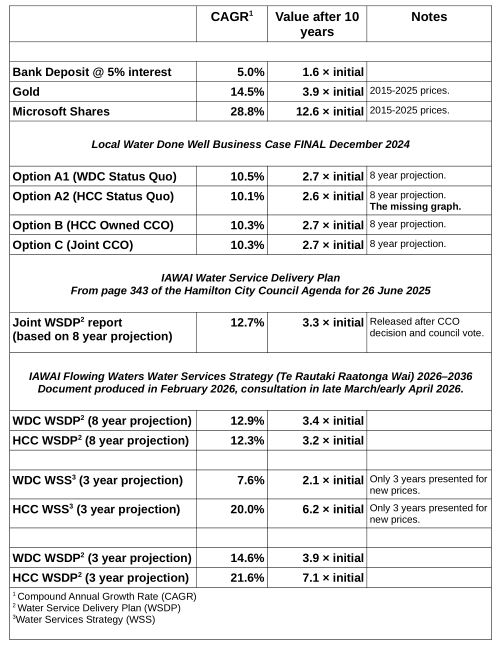
CAGR is usually used to compare different investment options, in the case of water charges it is used to compare the average annual price increases for the average household.
Conclusions and recommendations
From the 2024 Business Case through to the 2026 Waters Water Services Strategy, there appears to be an official intention to sell the idea of the new water company to councillors and public, rather than present a fair assessment of the merits of the different options. Critical data and graphs that indicate that the new joint water company could lead to higher costs for households in Hamilton City have gone missing from the various reports.
Officials, and the consultants they hire, should be providing the public and elected representatives with objective and unbiased assessments of the proposals. Critical information that makes a preferred option look bad should not be hidden, missing, or removed in the reports released to the public.
If the transfer of water services to IAWAI is completed in July, it will be a triumph of marketing over merit.
Creating IAWAI is looking more like an expensive mistake. The projections released to the public show extreme cost increases that will burden households and future generations. We can guess that the projections not released to the public show something even worse for Hamilton households.
May and June is a critical time to keep pressure on in efforts the halt IAWAI taking control of Hamilton City Council’s water assets. You can contact your elected representatives (Mayor, councillors, MPs, Minister for Local Government) as well as potentially the Commerce Commission and the Office of the Auditor-General.
These are the kinds of questions I will be asking them:
- Why was only the “HCC Status Quo (Option A2) Annual change in rates per connection” graph left out of the Local Water Done Well Business Case FINAL December 2024 document when the graphs for Option A1, B, and C were included?
- Was leaving out that Option A2 graph bad faith behaviour to promote Option C (joint CCO), given that Option A2 appeared better in terms of lower annual costs to households in Hamilton City after 2032?
- Is the average household in Waikato District currently paying around three times more annually than the average household in Hamilton City due to the higher institutional costs associated with Watercare’s CCO model and/or water metering?
- Does “price harmonisation” mean that annual water costs for an average household in Hamilton City will at least triple to approximately match the annual water costs for an average household in Waikato District?
- Are Waikato District households getting the better deal from the formation of IAWAI, at the expense of higher annual water costs for households in Hamilton City?
- Why was Wellington given projections for household water costs out to 2035/2036 in the Tiaki Wai Waters Water Services Strategy, yet the IAWAI Waters Water Services Strategy does not give us WSS projection at the household level past 2029?
- Under IAWAI models (not included in the IAWAI WSS released in March 2026) when is “price harmonisation” expected to occur and is the average household’s water cost in Hamilton City expected to be over $6000/year before 2036?
- How much has been spent on IAWAI setup costs such as branding, consultants, IT, new boards, merger activities, and new personnel?
- Which senior managers, executives, and elected officials at Hamilton City Council are going to be taking an approximately 30% reduction in hours and pay to reflect water services activity being transferred to IAWAI?
[Minor edits: 08/05/2026]
[Edits: 14/06/2026, updated extrapolation estimates for “price harmonisation” of median household water bills in 2036-2037: “9.4” years has been updated to “10 years”, with “$6447 (WDC) and $6872(HCC) per year around 2036” replaced with “estimated to be $6449 (WDC) and $6893(HCC) per year in 2037. Around 2036, WDC and HCC median household bills are projected to be equal at approximately $6000 per household per year.” Graph of the projections and extrapolations added].
[The content of any Opinion pieces represents the views of the author and the accuracy of any content in a post labelled Opinion is the responsibility of the author. Posting of this Opinion content on the CityWatch NZ website does not necessarily constitute endorsement of those views by CityWatch NZ or its editors. CityWatch NZ functions to provide information and a range of different perspectives on New Zealand’s cities and local councils. If you disagree with or dispute the content, CityWatch NZ can pass that feedback on to the author. Send an email to feedback@citywatchnz.org and clearly identify the content and the issue.]
Further reading on this issue:
OPINION: Feedback on the IAWAI Water Services Strategy (April 2026)
Household Water Costs in Hamilton City Projected to Triple within 9-years under New Water Company
OPINION: Is Removing Water Services from Rates an Existential Threat to Councils?
OPINION: Serious Mismanagement and Lack of Accountability with Water Services