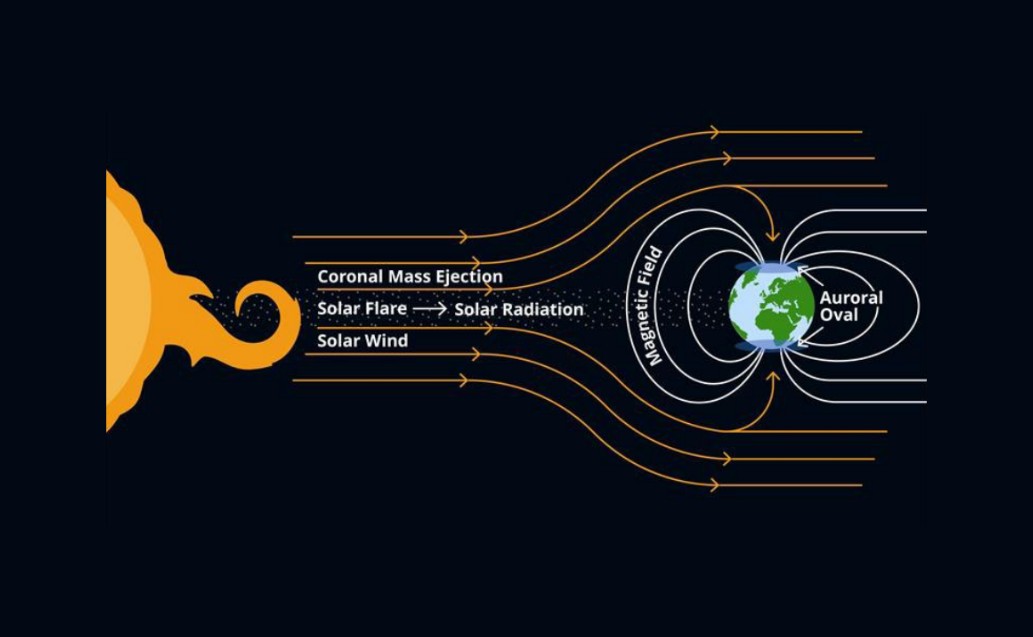
Graphic from the National Space Weather Response Plan.from New Zealand’s National Emergency Management Agency (NEMA)
Summary
-
On 07 November 2025 the National Emergency Management Agency held a space weather exercise under the Beehive in Wellington.
-
The National Emergency Management Agency (NEMA) was formerly known as Civil Defence.
-
RNZ reported on the “simulated emergency response to solar storm” held under the Beehive.
-
RNZ also reported on an actual solar storm hitting Earth at the time of the exercise.
-
NEMA published the the National Space Weather Response Plan about a year earlier in November 2024.
-
The National Space Weather Response Plan covers New Zealand’s national response to space weather events such as solar flares, coronal mass ejections, and geomagnetic storms.
-
Every 11-years the Sun’s activity reaches a maximum with higher numbers of sunspots and a higher likelihood of a space weather events disrupting infrastructure.
-
2024-2025 is the expected peak of the current sunspot maximum, with a higher likelihood of disruptive space weather expected to last until about 2027.
-
Space weather events from the Sun can disrupt communication systems, electronics, and electricity grids.
-
The severity of space weather events vary and information on the expected severity can arrive between a few days and 15 minutes before the event impacts infrastructure on Earth.
-
New Zealand’s plan to protect the electricity grid from a major coronal mass ejections and the resulting geomagnetic storms, is detailed National Space Weather Response Plan.
-
To protect New Zealand’s electricity grid Transpower plans to disconnect vulnerable parts of the grid (such as transformers). This protective measure could result in parts of the country being without power for up to 6 days. Without such protective measures, serious damage to sensitive parts of the electricity grid infrastructure could result in outages that last a month or much longer.
-
New Zealand’s plan to protect the electricity grid from a major coronal mass ejections and the resulting geomagnetic storms, is detailed in the National Space Weather Response Plan.
-
A space weather hazard poster from NEMA predicts a 30% chance of an “extreme” space weather event in terms of “likelihood in the next 50 years”. This likelihood was 6 times higher than a magnitude 7.5 earthquake occurring in Wellington over the next 50 years.
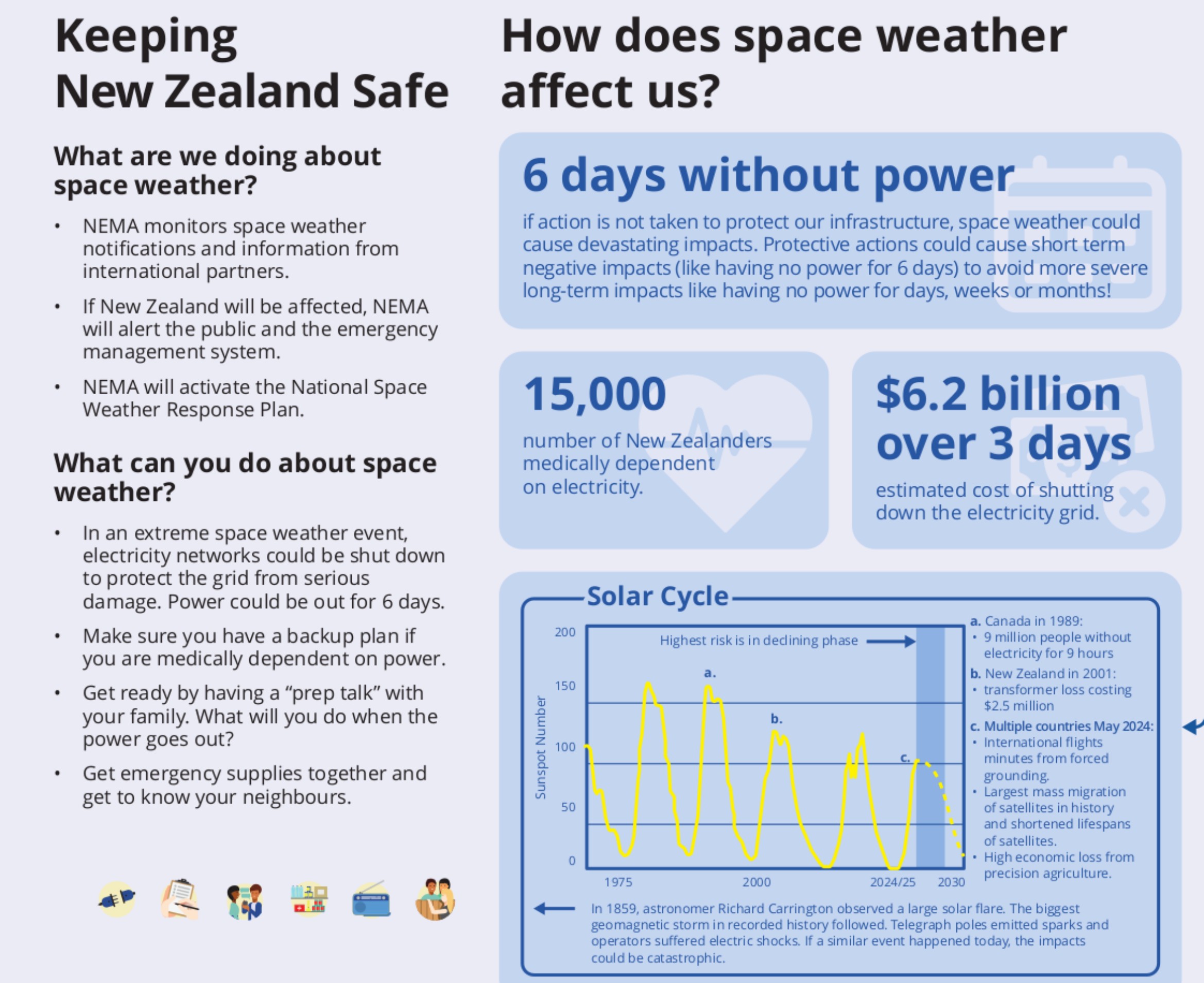
Our Hazards: Space Weather (A3 Poster), National Emergency Management Agency (NEMA), March 2025.
Quotes
“Space weather is a natural hazard that has always existed. But in today’s interconnected world, bursts of solar energy thrown out by the Sun now have the potential to be catastrophic for societies on Earth. A significant space weather event will disrupt critical infrastructure and essential services, preventing communities from accessing essential goods, and potentially impacting the ability for society to function as we know it. Impacts may be on a global scale with long restoration times…
…In May 2024, a large space weather event reinforced the urgency of advancing our understanding of this hazard. We know that the forecast “solar maximum” – the period of high storm activity on the Sun’s surface – is already under way, lending further urgency.
In June 2024, NEMA established our Space Weather Programme, to rapidly understand the hazard and inform operational readiness and response arrangements ahead of the solar maximum. We worked with stakeholders and partners across government, the emergency management sector, iwi/Māori, the private sector, and internationally..
The Bill also clarifies that a private sector person can receive a commercial return on investment and that the funds the Government raises from a concession arrangement can be spent on new road projects.”
Civil Defence Emergency Management Director John Price, foreword of the National Space Weather Response Plan, National Emergency Management Agency, November 2024
“There are three main types of event: radio blackout, solar flare, and coronal mass ejection.
Warning times that New Zealand can expect
Coronal mass ejection event: at least 12 hours, but arrival times vary: the bigger the event; the less advance warning.
Satellites can tell us more about the size and type of event between 15 and 60 minutes before the event impacts Earth.
Radio blackout event: from minutes to hours
Solar flare: from minutes to hours, or no warning.
If a significant storm is detected, NEMA’s MAR Centre will contact Transpower and other stakeholders, and activate NEMA’s standard operating procedures for a space weather event.
These procedures focus on the impact to New Zealanders from a major infrastructure failure.”
National Space Weather Response Plan, National Emergency Management Agency, November 2024
Links
Headline: Simulated emergency response to solar storm exercise run for first time
Published on: 07 November 2025
Authored by: Kate Green
Published by: RNZ
Title: National Space Weather Response Plan
Published on: November 2024
Published by: National Emergency Management Agency


